In the fall of 1777, General Sir William Howe had the upper hand. He commanded the British army in America, and since late September he had held Philadelphia, the American capital. Washington did not let him settle in. Before dawn on October 4, the Americans marched on Howe’s camp at Germantown, about seven miles northwest of the city, and struck it from several directions. But the morning was thick with fog, the smoke of battle made it worse, and the attack dissolved into confusion. Within hours Washington’s men were falling back.
Two days later, Washington still had business with General Howe. Two pieces of it, in fact. One was a quarrel. The other was a dog.
The quarrel had come from Howe, who wrote to protest that American parties were disabling mills near his army. Washington was in no mood to apologize. He told Howe he was “somewhat at a loss” to understand the letter, and said he hoped the British would now give up their own “wanton & unnecessary depredations.” The examples, he added, “need not be enumerated.” “Your own memory will suggest them to your imagination.” Then, having said they need not be listed, he listed some anyway, from the destruction of Charlestown to the recent burning of mills, barns and houses.
The dog was another matter entirely. At some point it had fallen into American hands, and the inscription on its collar seemed to name its owner. On October 6, Washington sent it back to Howe with a note just two sentences long:
General Washington’s compliments to General Howe. He does himself the pleasure to return him a dog, which accidentally fell into his hands, and by the inscription on the Collar appears to belong to General Howe.
Draft in Alexander Hamilton’s hand · October 6, 1777
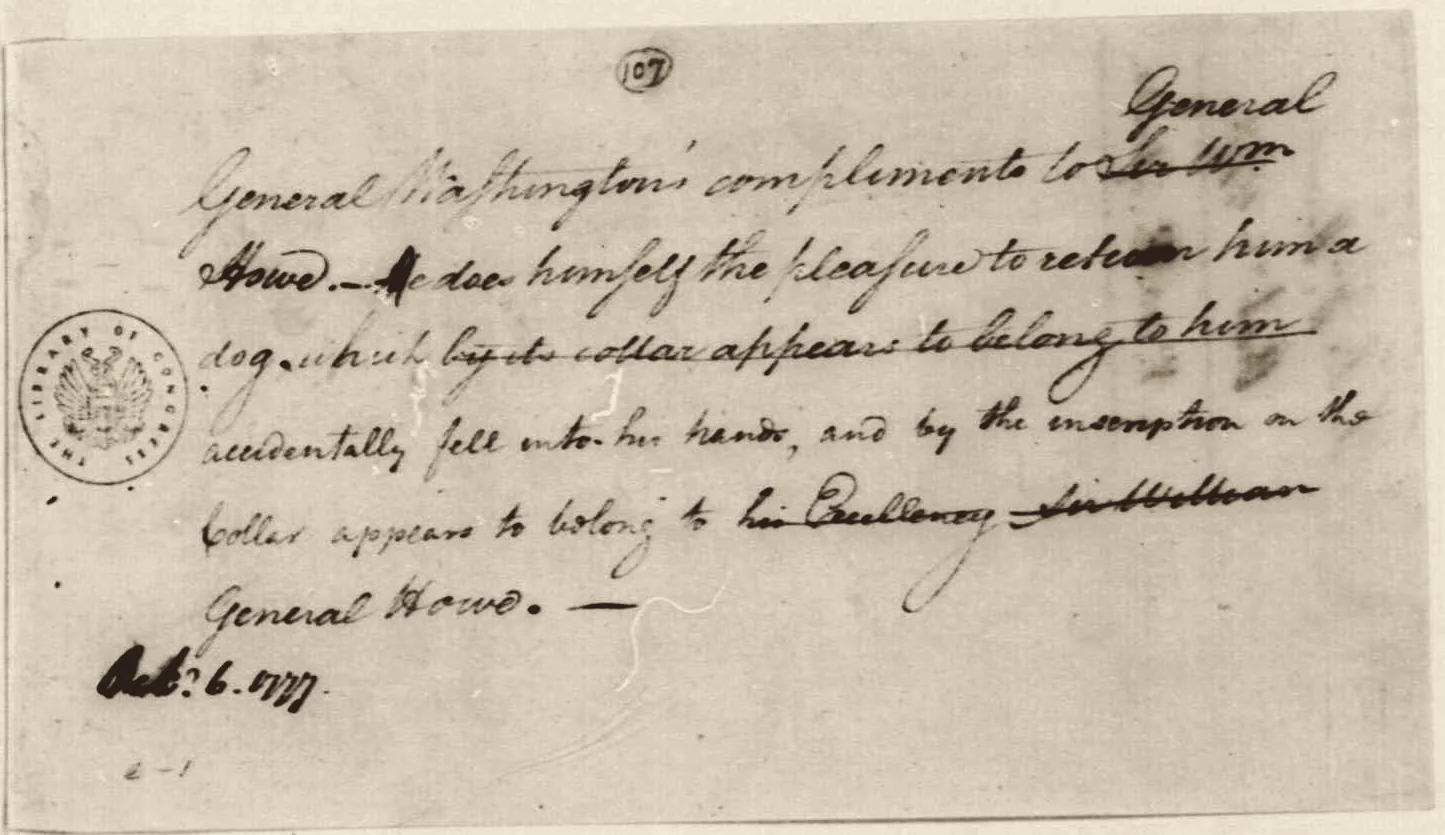
- 1 “Sir Wm.” struck out
- 2 “General” written above
- 3 “his Excellency” and “Sir William” struck out
- 4 “General Howe” kept
The handwriting belongs to Washington’s young aide, Alexander Hamilton, and his draft, which survives in the Library of Congress, shows him wrestling with one small question: what to call the enemy. In the first line he wrote “Sir Wm.,” struck it out, and wrote “General” above it. At the end of the note he tried “his Excellency,” then “Sir William,” and struck those too. He settled on “General Howe.”
It was not fussiness. Fifteen months earlier, the same question had run the other way. In July 1776, a British officer came up to New York under a flag of truce carrying a letter from the general’s brother, Admiral Lord Richard Howe. It was addressed to “George Washington Esqr.,” as though Washington were a private gentleman. His adjutant general, Joseph Reed, refused to accept it. As Washington told Congress, Reed informed the officer that there was “no such person in the Army.” Washington said he “would not upon any occasion sacrifice Essentials to Punctilio,” but in this instance he considered it a duty to his country and his appointment to insist on that respect.
Now, with his enemy’s dog in hand, he paid that respect back in full.
It fits what we know of Washington at home. He bred hounds at Mount Vernon and noted them in his diary. On August 6, 1768, he noted a new litter of four and gave every pup a name: Vulcan, Searcher, Rover, and a red spotted female called Sweetlips.
A man who names his puppies in his diary does not keep another man’s dog. Not even the enemy’s.
Publius

The Publius Papers · No. 1
Sources
- George Washington to General William Howe, October 6, 1777 (the dog). Founders Online, National Archives.
- George Washington to General William Howe, October 6, 1777 (the mills). Founders Online, National Archives.
- George Washington to John Hancock, July 14, 1776. Founders Online, National Archives.
- George Washington, diary, August 1768. Founders Online, National Archives.